Question: How can I create a sacred space for healing and prayer at home?
A sacred space is not about the objects you arrange on a shelf. It is about training the mind to cross a threshold.
Most spiritual traditions have always understood this. Churches, mosques, temples, druidic groves, the magic circle in Wicca. What these places share is not architecture. It is the act of separation from ordinary consciousness. When you step into them, something in you recognises that this moment is different from the one before it. A home altar, a lit candle, a chair you sit in only for prayer — these work on the same principle. You are not decorating. You are creating a cue.
The Container Comes Before the Practice
In shamanic work, the first ritual in any ceremonial or transformative practice is to create a sacred container. A safe space to enter into a different quality of consciousness. The container is not the work itself. It is what makes the work possible.
This can be as simple as lighting a candle. Burning sage or incense. Sitting quietly in front of an altar. Putting down your phone. These are not preparatory gestures. They are the practice. The mind needs to know that it is reaching beyond its ordinary limitation. The container gives it that signal.
What matters is that the signal is consistent. A corner of a room, used at the same time, with the same small rituals, becomes a place the nervous system learns to soften in. You do not need a dedicated room. You do not need anything expensive or elaborate. You need repetition and intention. The two together are what make a space sacred rather than merely decorated.
Breath Is Always Available
The most portable container is the one you carry with you. The breath.
If you are in pain, in distress, or want to enter into a different quality of attention without any apparatus, the breath is enough. Becoming aware of it is the act. Not controlling it. Not deepening it into a performance. Just noticing it. This is how you create sacred space on a subway, in a waiting room, in the middle of noise and crowd.
The breath marks the boundary between ordinary time and ceremonial time. It does not require you to be somewhere special. It requires you to arrive in your own body, which is where the practice actually happens. Trauma often pulls us out of the body. The body becomes something to escape rather than inhabit. Coming back to the breath is one of the smallest, most direct ways of returning home to it.
Calling In the Directions Orients You to Something Larger
One practice that appears across many traditions is the calling of the four directions. It is a way of situating yourself inside a larger field before you begin prayer or meditation. In the source prayers here, this is named precisely: East for new beginnings, South for manifestation, West for intuition, North for ancient wisdom. Above, infinite possibility. Below, the grounding of earth. And at the centre, what is described as the eternal flame of consciousness within the heart.
You do not have to believe in the literal cosmology to work with this practice. What it does, practically, is widen the frame. It moves attention from the personal problem to the larger context. When you are in pain or confusion, the mind contracts. It narrows to the wound. Calling the directions is a way of deliberately expanding that field before you bring your specific situation into it.
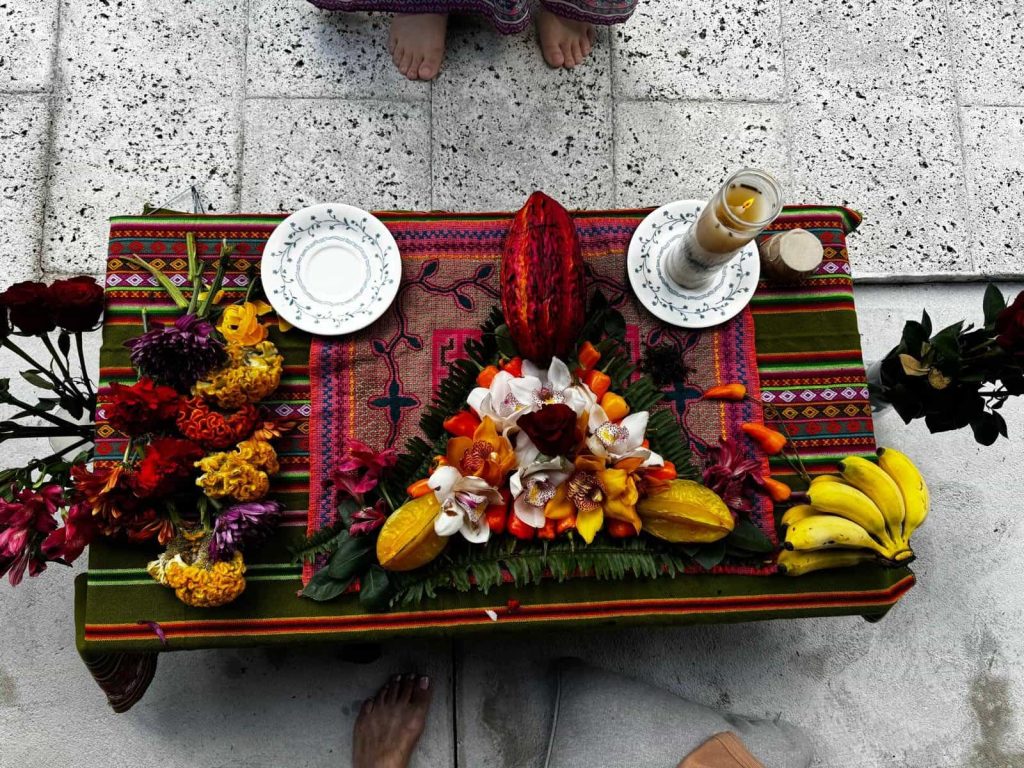
This is why the altars most people build tend to include something from the natural world. Stones, water, a plant, a feather. These are not decorative elements. They are reminders that the body and the earth share the same substance. The forgetting that we are nature, not separate from it, is its own form of wound. An altar that includes the natural world is a small daily act of remembering.
The Impossible Problem Belongs on the Altar
There is a particular kind of prayer that does not ask for understanding or resolution. It simply names what is true and hands it over.
In recovery traditions, the phrase is: let go and let God. What this points to is a specific practice — not a passive giving up, but a deliberate act of placing something you cannot solve in a space larger than your own thinking. The altar in your home can serve exactly this function. Not as a place where you perform your spiritual credentials, but as a place where you put what is too heavy to hold.
The language used here is the altar of your heart. And even one word, the word help, is described as enough to activate that frequency. A home altar externalises that internal act. It gives the mind a physical location for the thing it cannot carry alone.
This is not magical thinking. It is the recognition that the mind loops. It returns to the same problem, the same wound, the same calcified fear, and interprets that repetition as engagement. Placing the problem on an altar is a way of breaking the loop. You have named it. You have acknowledged it. And you have placed it somewhere outside the spinning of ordinary thought.
The prayers in this tradition are not performances of faith. They are specific utterances — for stillness, for vision, for heartbreak, for patience — each one an act of putting the situation into language and releasing it. Saying the prayer at your altar, at the same time, in the same posture, is the practice. The altar does not make the prayer more powerful. It makes the prayer more possible.
If you want to go further into this territory, subscribe to my newsletter, where I write regularly about the practices that have actually held me.